
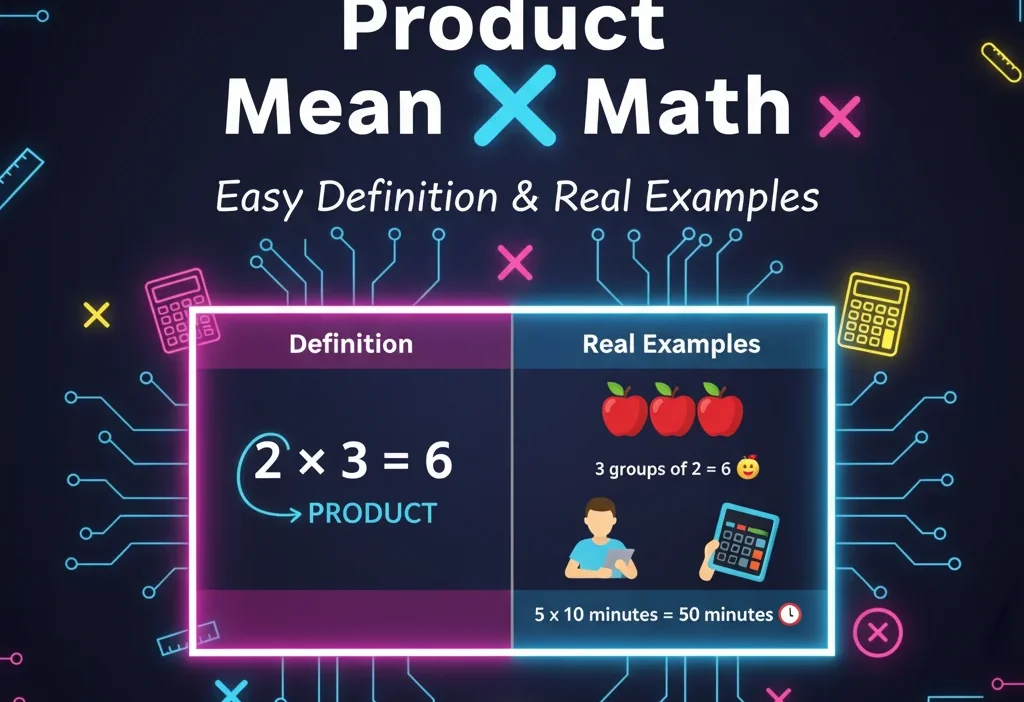
Ever heard your math teacher say, “Find the product of these numbers,” and felt a bit unsure what that meant? 😅 You’re not the only one! Many students first meet the word product early in school and assume it’s something to buy not a math idea.
But in mathematics, “product” has a special meaning that shows up everywhere — from basic multiplication to algebra and geometry.
✨ Quick Answer:
In math, “product” means the result of multiplying two or more numbers together.
It’s a small word with a big role — and understanding it will make a lot of math concepts finally click!
🧠 What Does “Product” Mean in Math?
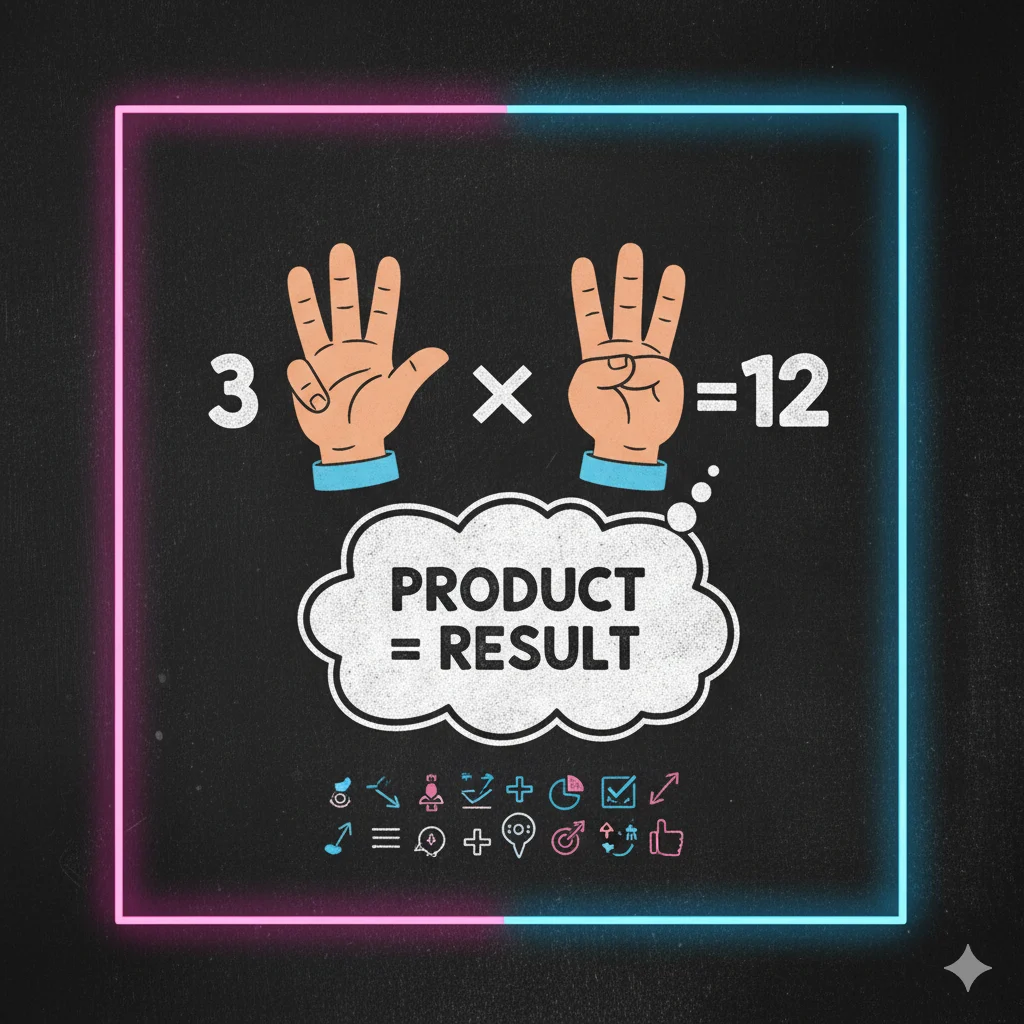
In mathematics, the product is simply the result you get when you multiply numbers.
✅ Example:
- 4 × 5 = 20 → The product is 20
- 2 × 3 × 6 = 36 → The product is 36
You can think of product as the “final outcome” of multiplication.
If “sum” means addition and “difference” means subtraction,
then “product” = multiplication result.
🧩 Quick Example Sentence:
“The product of 8 and 7 is 56.”
In short:
👉 Product = Result of Multiplication
💡 Pro Tip: The word product always signals multiplication — never addition, subtraction, or division.
📱 Where Is “Product” Commonly Used in Math?
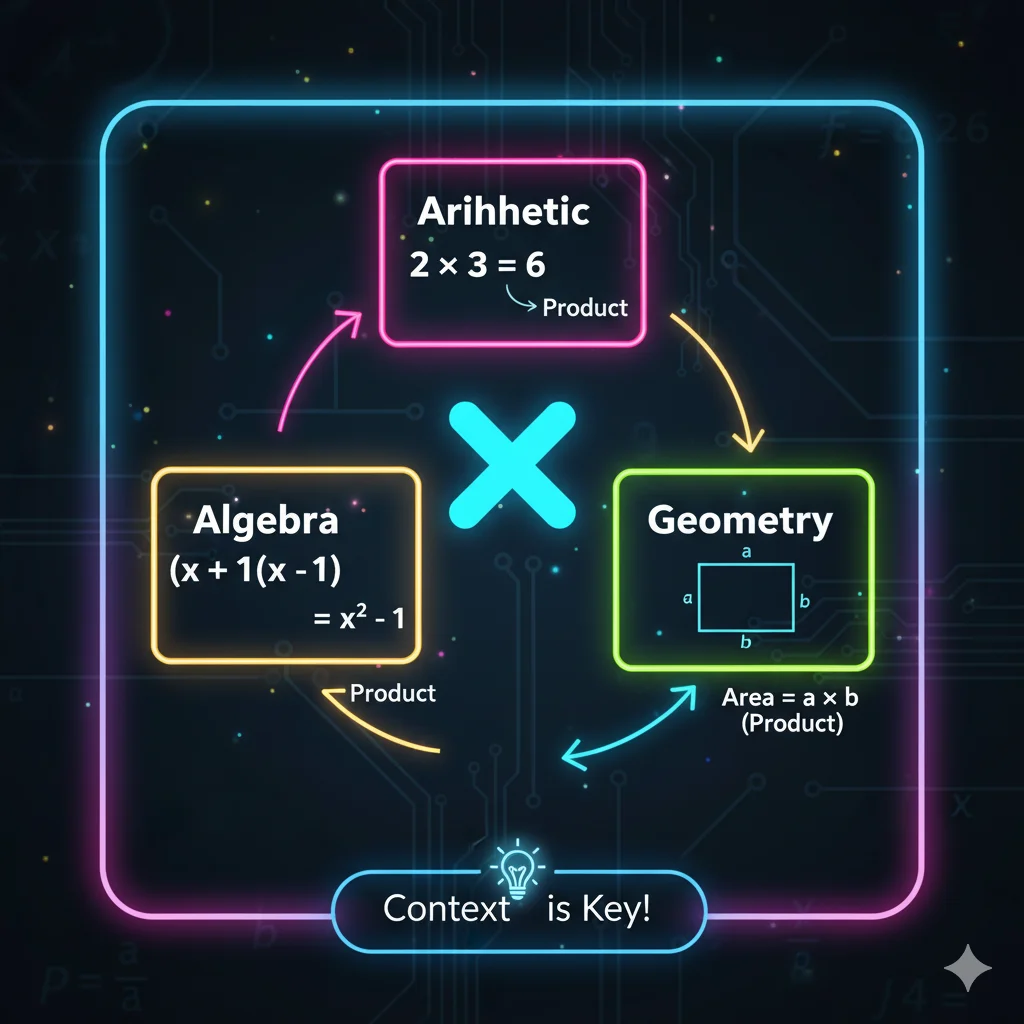
You’ll find “product” all over the math world — from simple sums to complex formulas. Here’s where it pops up most often 👇
🔹 Basic Arithmetic
Used when multiplying numbers, fractions, or decimals.
Example: The product of 2.5 and 4 is 10.
🔹 Algebra
When multiplying expressions:
(x + 2)(x + 3) → You’re finding the product of two binomials.
🔹 Geometry
In geometry, product shows up when calculating area or volume.
- Area = length × width
- Volume = length × width × height
🔹 Everyday Examples of Product in Action
- Shopping: Price × Quantity = Total cost
- Traveling: Speed × Time = Distance
- Fitness: Calories burned = Rate × Duration
💬 Friendly Reminder:
“Product” is formal enough for classrooms 📘 but simple enough for daily life — anytime you multiply, you’re finding a product.
💬 Examples of “Product” in Conversation

Here’s how “product” naturally fits in everyday math talk 👇
Example 1
A: What’s the product of 9 and 6?
B: 54!
Example 2
A: The product of two negatives is positive, right?
B: Exactly 😄
Example 3
A: What’s the product of 3x and 4y?
B: That’s 12xy.
Example 4
A: Isn’t area just the product of length and width?
B: Yup, correct!
Example 5
A: I multiplied by 0 — is the product 0?
B: Always!
These short convos make the concept easy to remember — product = result of multiplication.
🕓 When to Use and When Not to Use “Product”
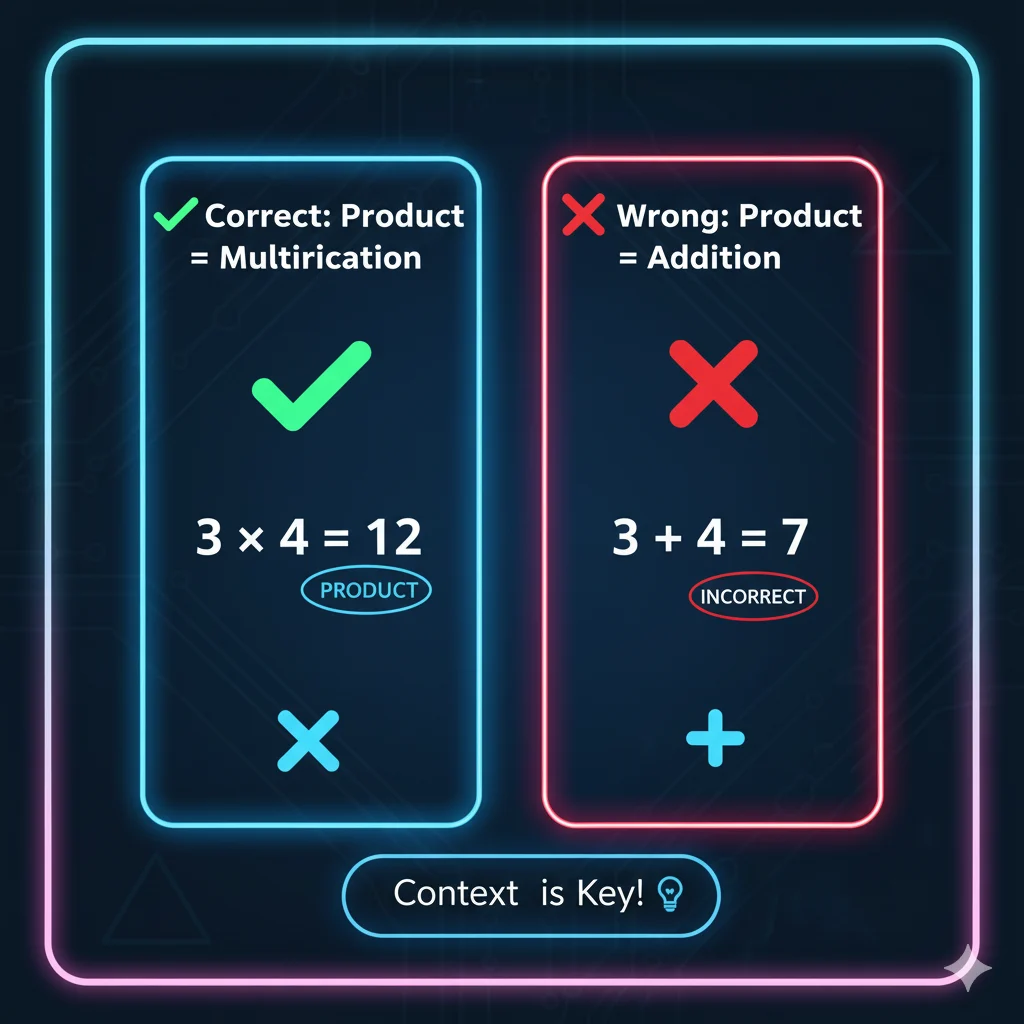
✅ When to Use:
- When you’re talking about multiplication results
- In math problems, geometry, and algebra
- While calculating area, volume, or totals
- During classwork or homework
❌ When Not to Use:
- For addition (use sum)
- For subtraction (use difference)
- For division (use quotient)
- In casual or non-math talk (“this product smells nice” 😆)
| Context | Example Phrase | Why It Works / Doesn’t Work |
|---|---|---|
| Arithmetic Class | “The product of 7 and 8 is 56.” | ✅ Correct — multiplication result |
| Geometry | “Area is the product of length and width.” | ✅ Accurate math usage |
| Daily Conversation | “The product of our friendship is happiness.” | ❌ Not mathematical |
| Work Email | “This product improved our sales.” | ❌ Different meaning (item, not math result) |
| Algebra Homework | “Simplify the product of (x + 1)(x + 2).” | ✅ Perfect mathematical use |
🔄 Similar Math Terms or Alternatives
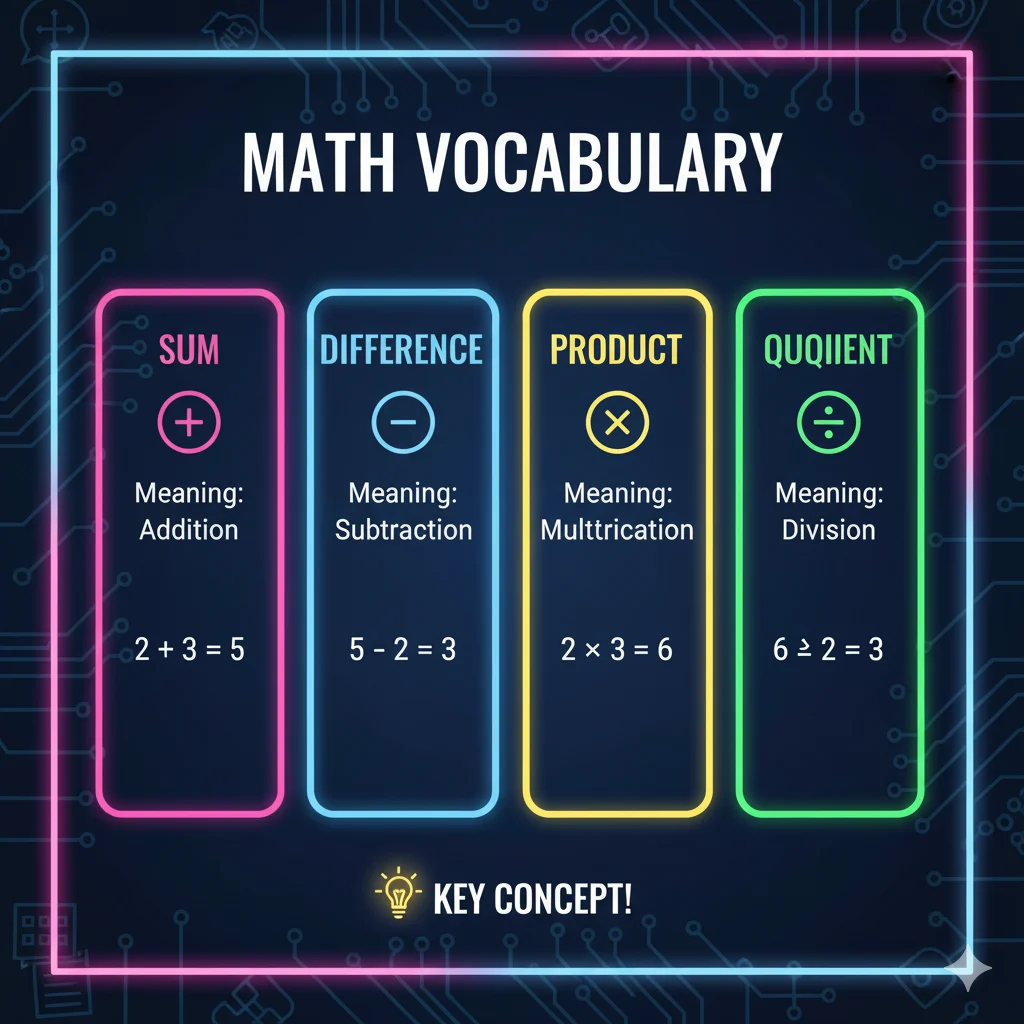
Math uses specific words for each operation — here’s how product fits among them:
| Term | Meaning | When to Use |
|---|---|---|
| Sum | Result of addition | When adding numbers |
| Difference | Result of subtraction | When subtracting one from another |
| Quotient | Result of division | When dividing numbers |
| Factor | Number or term being multiplied | When identifying components of a product |
| Multiple | Result of multiplying a number by an integer | When listing products of a number |
| Coefficient | Number multiplying a variable | When working with algebraic terms |
🧠 Think of it this way:
If you’re putting things together (sum) or taking away (difference), you’re not multiplying. But when you’re combining values by scaling, that’s the product.
❓ FAQs About “Product” in Math
Q1. What’s the difference between a product and a factor?
Answer:
A factor is a number you multiply. The product is the result.
Example: 3 × 5 = 15 → 3 and 5 are factors; 15 is the product.
Q2. Can the product be zero?
Answer:
Yes! If any factor is 0, the product is 0. (9 × 0 = 0)
Q3. What’s the product of negative numbers?
Answer:
Two negatives make a positive. (–4 × –2 = +8)
Q4. How do you find the product in algebra?
Answer:
Multiply coefficients and variables. Example: (2x)(3y) = 6xy.
Q5. Why is it called “product”?
Answer:
It comes from Latin productum, meaning “something produced” — the number produced by multiplication.
🧩 Final Thoughts
So, what does “product” mean in math?
It’s simply the result of multiplication, whether you’re working with numbers, variables, or real-life quantities.
Whenever you multiply, the answer you get — big or small — is always called the product.
💡 In short:
Product = Multiplication Result = The Answer You Produce